Biosocial Team

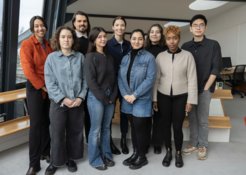
© MPI for Human Development
Research Group Leader

Laurel Raffington
Research Group LeaderDr. Laurel Raffington’s research spans the fields of developmental psychology, genomics, and public health. Her research seeks to understand how systems of social inequality and genetically-influenced differences between people combine to shape differential outcomes of education, health, and well-being across the lifespan and across generations. Laurel has two kids and wants to help make the scientific community more inclusive to scholars from commonly underrepresented groups.
Team

Muna Aikins
Predoctoral FellowMuna Aikins’ academic background is in social science and human rights. Her doctoral research examines how experiences in childhood and adolescence tied to racism get under the skin to influence mental and physical health inequalities across the life span. Her research and work are based in Black communities’ activism and movements.

Deniz Fraemke
Predoctoral FellowDeniz Fraemke is a cognitive neuroscientist. He is interested in how cognitive development and educational attainments are influenced by the synergistic interplay between genetic variation and childhood socioeconomic inequalities. Deniz is committed to climate justice and sails across the globe in his remaining time.

Nadia Harerimana
Predoctoral FellowNadia Harerimana has a background in population genetics, computational biology, and neurodevelopment diseases. Her research focuses on understanding genetic variation through social and historical lenses, particularly exploring the intersection of genetics, geography, and socio-economic outcomes. Beyond her academic work, Nadia is committed to science communication and outreach, empowering underrepresented communities and shaping global conversations on genetics and public health.

Yayouk Willems
Research ScientistDr. Yayouk Willems is a developmental psychologist and behavior geneticist. Her projects explore how genetic propensities affect self-control, substance use, and health within the constraints imposed by socially-stratified environments. Yayouk is a multidisciplinary thinker who aims to make science more actionable and comprehensive for policy makers and the general public.

Qiao Wu
Research ScientistDr. Qiao Wu is a gerontologist and epidemiologist specializing in biological aging. His research leverages multi-omic biomarkers to measure biological aging and assess socio-environmental exposures, with the goal of understanding how social, behavioral, and environmental factors across the life course become biologically embedded to influence health trajectories and aging outcomes. Committed to multidisciplinary and translational science, Dr. Wu’s work bridges population research, molecular epidemiology, and public health. His teaching experience covers global health and aging, quantitative methods, and applied economics.
